




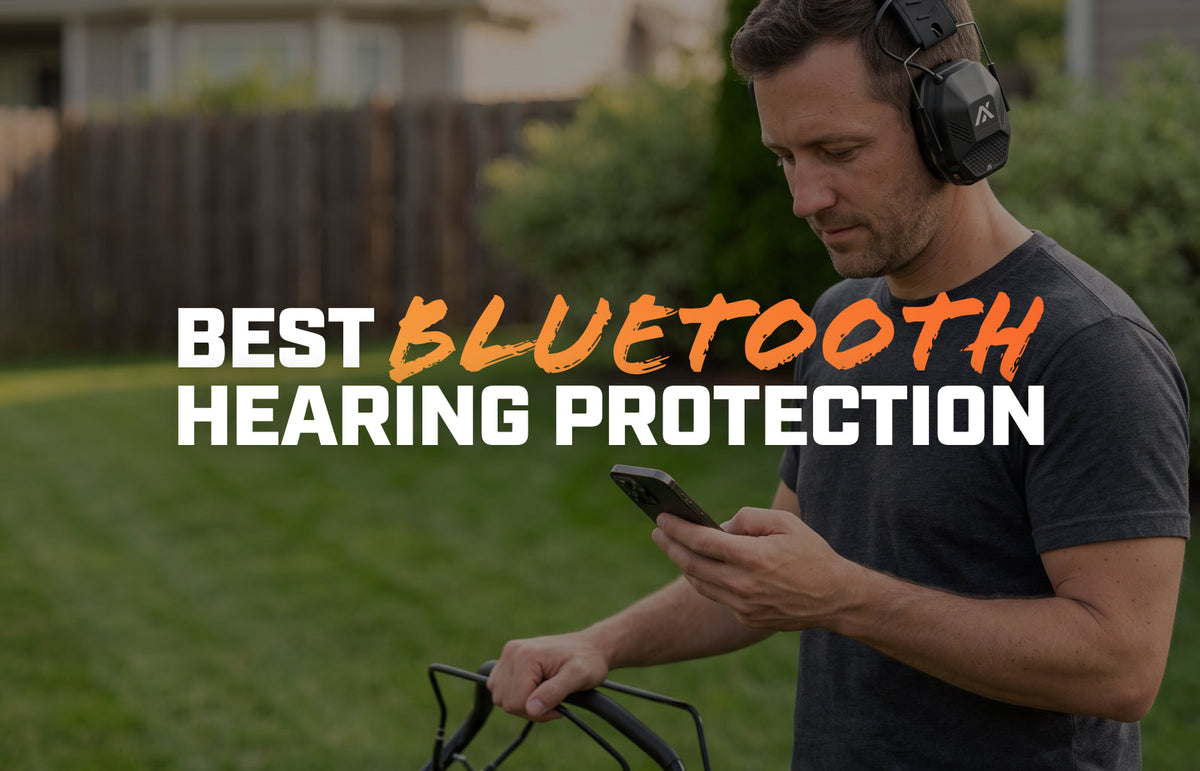
You're halfway through mowing your lawn when your phone goes off in your pocket. You lift one earmuff to answer the call, mower still running beside you. That same ear stays uncovered for the length of the call, taking all the noise damage from the mower without you even noticing.
Bluetooth hearing protection is built for that scenario. Your earmuffs, earbuds, or earplugs rely on a seal around your ear to protect your hearing. Any time that seal is disrupted, your hearing protection gear fails.
Bluetooth hearing protection holds that seal while a phone call comes through the same speakers that handle your hearing enhancement.
A shooting range, a job site, and yard each ask something different from your hearing protection gear.
| Where you spend your time | Hearing protection gear that best fits | Why |
|---|---|---|
| Indoor range | Bluetooth earmuffs | Highest ratings, and no insertion technique to get wrong |
| Outdoor range, rifles, and shotguns | Bluetooth earbuds | Nothing between your cheek and your rifle stock |
| Full days on a job site | Bluetooth earmuffs | 30 to 40 hour runtimes, easy to take on and off between tasks |
| Working under a hard hat | Bluetooth earbuds | Your headwear never touches the seal |
| Mowing, sawing, and yard work | Bluetooth earbuds | Rated against sweat and rain, stays comfortable for hours |
| A spare pair for your truck | Passive earplugs | Cheap, and has no battery that needs charging |
What Bluetooth Adds to Hearing Protection, and What It Costs
Bluetooth does not weaken your hearing protection. The wireless audio path and the compression circuit are separate systems, and neither involves wireless audio.
Your ear cushion or ear tip provides the physical seal that protects your hearing. A compression circuit clamps a loud sound before your speakers pass it along your ear, and AXIL sets that circuit at 85 dB across the electronic line.
Bluetooth Adds Calls, Streaming and a Reason to Keep Your Protection On
A Bluetooth feature in your hearing protection gear lets you take a call without lifting an earmuff off your ear. You would be able to stream music and podcasts through the same speakers carrying your hearing enhancement, so your protection stays sealed through a four hour job or a two hour shooting range session.
Some models hold a link to a second device, which keeps your phone and your truck stereo connected at the same time.
That gives you the benefit of not having to take your hearing protection off. Hearing protection only works while a pair is on your head. Every reason to pull off your gear is a moment when your ears are at risk.
Bluetooth Costs You a Battery and a Charging Habit
A wireless audio path needs power, which means a battery in your earmuffs or your earbuds and a charger to plug them into. AXIL carries the CRX LINK adaptor that adds Bluetooth to its CRX earbuds at a slightly higher price point than just the base earbuds.
One thing to check before buying Bluetooth hearing protection is what happens to your gear when the battery dies out.
On most electronic hearing protection, the ear cushion or ear tip still seals your ears even when it’s out of juice. You’ll keep your passive protection but lose your electronic hearing enhancement. Some models handle a dead battery differently, so check that behavior on the product page before you buy.
Tip: If charging your gear is the part you would often forget, look for a Bluetooth earmuff that runs on replaceable batteries. The SIG SAUER TRACKR BLU takes two AAA cells, so you can carry spares in your range bag.
You can learn more about compression circuits and reaction speed on our guide to how electronic hearing protection works. The Bluetooth feature itself matters less than the form factor carrying it.
Bluetooth Earmuffs vs Earbuds vs Earplugs

Bluetooth earmuffs, Bluetooth earbuds, and passive earplugs all seal your ears. How each gear gets the seal right decides which of the three belongs in your bag.
| Bluetooth earmuffs | Bluetooth earbuds | Passive earplugs | |
|---|---|---|---|
| Typical AXIL rating | 22 dB NRR to 30 dB SNR | 17 to 23 dB NRR | 13 to 19 dB NRR |
| Runtime, audio plus enhancement | 30 to 40 hours | 5 to 15 hours | No battery |
| Getting a consistent seal | Put them on and you're sealed | You have to choose the right tip size for your ear and practice on how to get the seal right | You have to choose the right tip size for your ear and practice on how to get the seal right |
| Rifle cheek weld | Cup can catch your stock | Nothing in the way | Nothing in the way |
| Under a hard hat or a beanie | Headband fights your headwear | Unaffected | Unaffected |
| Heat and sweat | Cups hold heat on long days | Small contact area | Small contact area |
| AXIL price band | $138.99 to $153.99 | $123.06 to $307.67 | $38.99 |
Bluetooth Earmuffs Give You the Same Seal Every Time
An earmuff seals against the side of your head, so you just put a pair on and you get close to the rated protection. That’s it, you’re all set.
That ease of putting your hearing protection gear on and off suits a range regular, and anyone handing a pair to a guest shooter. Bigger gear housings also fit bigger batteries, so a Bluetooth earmuff can run 30 hours of music and hearing enhancement together.
The trade off is contact. Earmuff cups can hold heat on a summer afternoon, a headband fights your hard hat, and the edge of a cup can catch your rifle stock.
Bluetooth Earbuds Stay Clear of Your Rifle and Your Hard Hat
A Bluetooth earbud seals inside your ear canal, which leaves the outside of your head free. Nothing sits between your cheek and your rifle stock, your hard hat goes on normally, and a long afternoon doesn't turn into sweat under a foam cushion.
The tradeoff here is technique. A Bluetooth earbud only delivers its protection rating once you've sized the ear tip and seated it past the bend in your ear canal. Battery runtimes come down too, since a battery small enough to sit in your ear holds less charge.
Passive Earplugs Are Cheap and Easy to Carry Everywhere
Passive earplugs win a narrower argument. A pair with no battery can live in your truck, your range bag, and your mower shed easily. What you give up is the hearing enhancement feature and bluetooth audio, but you’ll get protection that's never out of charge.
Form factor decides which pair you can wear all day. The next thing to figure out is what type of hearing protection rating you need depending on your activity.
How Much Protection Do You Need for Your Environment?
A chainsaw, a push mower, and an indoor range are different problems, and one protection rating can’t serve all three.
The National Institute for Occupational Safety and Health (NIOSH) puts its recommended exposure limit at 85 A-weighted decibels across an eight hour day, and cuts the safe duration in half for every 3 dBA above that. Nine decibels of extra noise turns an eight hour allowance into one hour.
NIOSH measurements of landscaping equipment put a push mower at 86 to 92 dBA, a leaf blower at 95 to 106 dBA, and a chainsaw at 105 to 109 dBA. A push mower asks for a few decibels of reduction. A chainsaw asks for more than twenty, across every minute the saw runs.
Gunfire belongs in a separate category because that noise arrives inside a millisecond instead of across an hour. NIOSH reports gunfire often reaching 160 to 170 dB peak sound pressure. Indoor ranges push higher again, and NIOSH recommends doubling up with earplugs under earmuffs for that kind of impulse noise.
The doubling-up recommendation is why a landscaper and a range regular can land on different gear. A landscaper needs a rating that holds across eight hours. A range regular needs the rating plus a second layer for a few dozen loud instants.
Your Seal Decides How Much of That Rating You Get
NIOSH states that laboratory-based hearing protector ratings overestimate the protection workers get in the field. A well-seated 22 dB pair can beat a badly seated 30 dB pair.
Our guide to Noise Reduction Ratings discusses how those numbers are measured, and our decibel guide lists levels for more environments.
A rating matched to your environment is the first thing to check on a spec sheet. Six other specs decide whether a pair holds up for your daily use.
What to Check Before You Buy Bluetooth Hearing Protection
When you know what environment you’ll be working in and what target rating you need from your hearing protection, six other specs decide whether a Bluetooth pair actually works for you:
- Protection rating matched to your environment, in Noise Reduction Rating (NRR) or Single Number Rating (SNR), with the ear tip or cushion you'll use
- Runtime against your real session length, plus what your pair does when the battery reaches zero
- Pairing capability, including whether your gear can pair with two devices at once
- Microphone quality, if you take calls in a noisy environment
- Controls you can work with gloves or a shooting glove on
- Water and sweat resistance, with a published IP rating instead of a general claim
- Compatibility with the hard hat, helmet, or hat you often wear
Protection rating sits at the top because a lower number than what your environment demands won’t give you the hearing protection you need.
Pairing behavior is easy to skip past on a spec sheet. AXIL's MX PRO earmuffs run Bluetooth 5.4 and connect to one device at a time, so moving from your truck stereo to your phone means a manual reconnect. If you switch devices several times a day, look for multipoint by name.
Radio capability is also worth checking separately. Most current Bluetooth hearing protection streams from your phone instead of carrying an AM/FM tuner. If you want a radio built into your earmuffs, confirm the tuner on the spec sheet before you order.
Match the List to How You'll Use Your Gear
| Where you spend your time | Start with | Because |
|---|---|---|
| At an indoor range | Bluetooth earmuffs | Consistent seal for you and for anyone you hand a pair to |
| On a job site all day | Bluetooth earmuffs | Runtime clears a full day with audio running |
| Behind a rifle or in a stand | Bluetooth earbuds | Cheek weld and headwear stay normal |
| In the yard on weekends | Bluetooth earbuds with an IP65 rating | Sweat, rain and long sessions without cup pressure |
| Across all three | Bluetooth earbuds and a spare set of earplugs | One pair that travels, one pair that never needs charging |
AXIL's Bluetooth line divides along those same seven specs, mostly on rating, runtime and fit hardware.
AXIL Bluetooth Earmuffs, Earbuds and Earplugs, Matched to Your Activity
AXIL splits its Bluetooth line across the same three form factors, and each one has an obvious home.
AXIL Bluetooth Earmuffs for the Range and the Job Site
The MX PRO carries a 30 dB Single Number Rating and runs 30 hours with hearing enhancement and audio together. The MXII PRO carries a 22 dB NRR, an IP65 rating, and a compartment in the cup that stores a pair of AXIL earplugs for doubling up at an indoor range.
Best for: indoor ranges and full days on a job site.
The SIG SAUER TRACKR BLU is the slimline earmuff option if you want the co-brand. A 27 dB SNR and a 0.02 second compression reaction time run on two AAA batteries, so you carry spare cells instead of planning around a charger.
Best for: range days where charging is the part you'd forget.
AXIL Bluetooth Earbuds for Shooting, Work and the Yard
The GS Extreme 3.0 is the all-round Bluetooth earbud. Foam tips carry a 21 dB NRR, an Ingress Protection (IP) 65 rating handles rain and sweat, and 15 hours of combined use covers a full day outdoors. The concha locks hold the fit no matter how you move.
Best for: long days outside across shooting, work and yard equipment.
The XCOR PRO is the flagship in-ear gear, at a 21 to 23 dB NRR with foam tips, and six times amplification. Bluetooth audio and hearing enhancement run about five hours, which trades runtime for cheek weld and all-day comfort.
Best for: rifle shooters and hunters who need their stock to sit clean.
The CRX is the entry point into electronic protection at $123.06, with a 20 dB NRR on foam tips, and 10 hours of battery runtime. Bluetooth is not built in, so a CRX pair needs the CRX LINK adaptor before it will stream.
Best for: a first electronic pair for weekend saw and mower work.
AXIL Earplugs for the Pair That Lives in Your Truck
The X30i is the passive counterpoint for in-ear protection. A toggle valve on each earplug moves you between 19 dB NRR closed and 16 dB NRR open, with no battery involved. The same earplugs fit inside the MXII PRO cup, which makes them a good second layer for an indoor range session.
Best for: a spare pair for your truck, or anyone who decides electronics aren't worth it.
Bluetooth Ear Protection FAQs
Do Bluetooth ear muffs protect your hearing?
Yes, to whatever NRR or SNR the model carries. Your seal and your compression circuit do that work, and the Bluetooth audio path runs separately from both.
Is Bluetooth hearing protection OSHA approved?
OSHA rates the hearing protector, not the Bluetooth. Your rating and your fit are what the standard addresses, and some sites ban listening devices regardless of rating.
Can you listen to music and still hear a gunshot safely?
Yes. The compression circuit clamps the impulse at the microphone before your speakers pass it along, whether or not music is playing.
What happens when the battery dies?
Your ear cushion or ear tip keeps sealing on most models, so you hold your passive protection and lose hearing enhancement. Confirm the behavior on the product page before you buy.
What NRR do I need for mowing, shooting or a job site?
Around 20 to 25 dB NRR, well sealed, covers most outdoor shooting and yard equipment. If you're shooting indoors or running a chainsaw all day, consider earplugs under earmuffs.
Getting Your First Bluetooth Hearing Protection Right
Buy for the environment you're in most often instead of the one you just visit occasionally. A shooter who spends 40 weekends a year at an indoor range and two weekends in a deer stand should buy earmuffs for the range and borrow hearing protection for the stand. A full-time carpenter who spends a few weekends mowing their lawn should get hearing protection for the job site instead of the yard.
Once you have your gear in hand, give it a first session test to get the seal right. Put your pair on with the electronics off and talk out loud. Your own voice should sound boomy and muffled inside your head. If your voice sounds close to normal, air is leaking past your ear tip or your cushion, and the rating on the box is not reaching your eardrum. Go up a size in your ear tips and seat them again, or reposition your headband until your voice changes.
A good seal pays off more than any other gear spec. Your hearing enhancement sounds cleaner with less outside noise competing against it, your music sits at a lower volume, and your protection holds for the length of the day. A Bluetooth pair that seals properly gives you your protection, your conversation, and your audio at the same time, without you taking the gear off.
Shop AXIL Bluetooth hearing protection across earmuffs, earbuds and earplugs, and match your first pair to the noise you stand in most.


Share:
Coyote Hunting Gear: The Complete Equipment Guide for Predator Hunters
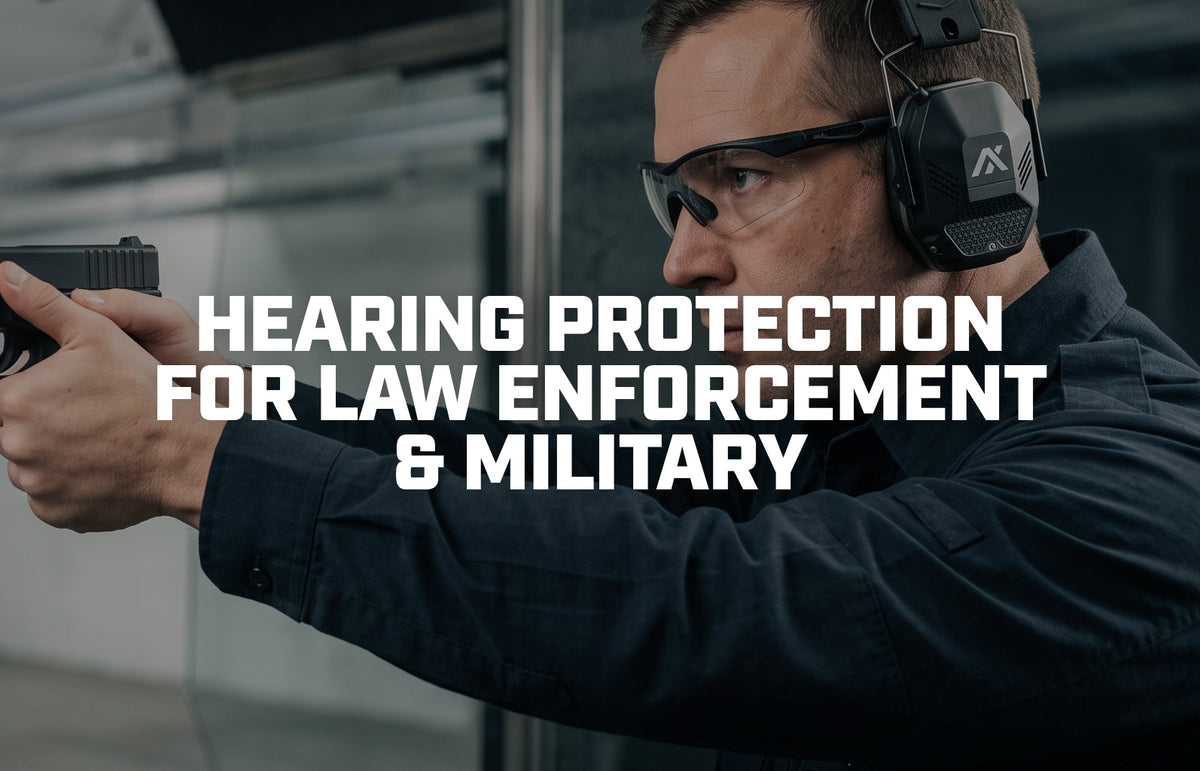
Hearing Protection for Law Enforcement and Military: A Duty-Use Buyer's Guide